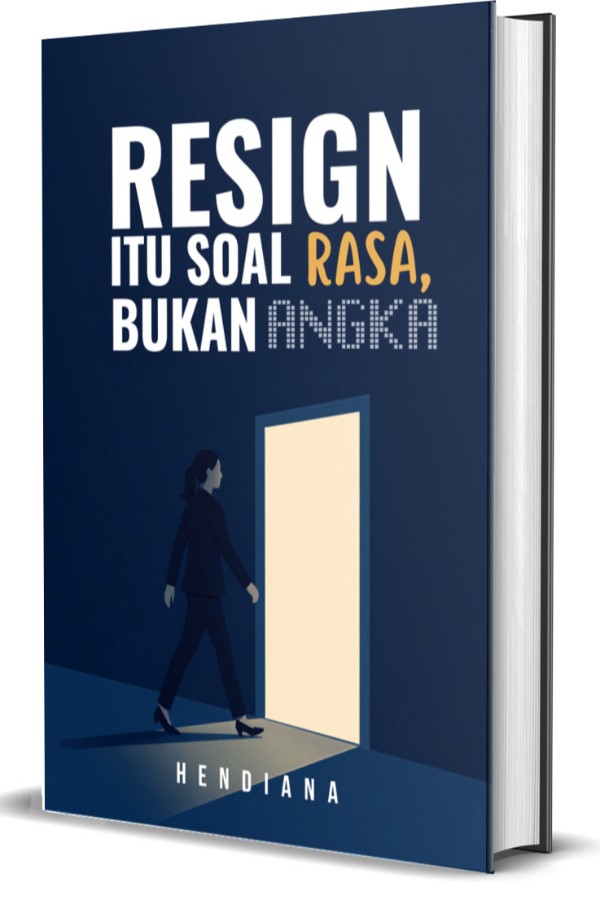
Resign itu Soal Rasa, Bukan Angka
KATA KUNCI
Resign, Karyawan, Kinerja, Perusahaan
Coming Soon
Buku sedang dalam persiapan. Pantau terus untuk info rilis!
Sejatinya, karyawan tidak meninggalkan perusahaan, melainkan meninggalkan manajernya. Kalimat klasik itu kembali mencuat dan memang terbukti kebenarannya. Pernyataan ini diperkuat oleh data terbaru dari Gallup, MIT Sloan, dan SHRM. Ternyata empati, bukan otoritas, yang menjadi kunci utama retensi dan kinerja perusahaan di era kerja modern saat ini.
Buku ini mengajak pembaca untuk melihat sisi manusiawi dari kepemimpinan. Dari kisah nyata Microsoft di bawah Satya Nadella hingga studi global Center for Creative Leadership, setiap bab membuka wawasan tentang performa tinggi yang tidak lahir dari kontrol yang terlalu ketat, melainkan hadir melalui hubungan yang hangat dan rasa dimengerti.
Melalui pendekatan berbasis riset dan pengalaman di lapangan, buku ini akan memandumu untuk memahami berbagai hal penting menyangkut kepemimpinan yang manusiawi:
- Bagaimana seorang manajer mampu menciptakan 70% variasi bagi engagement karyawan,
- Mengapa budaya toksik sepuluh kali lebih berbahaya daripada gaji rendah dan fasilitas yang tidak mewah,
- Bagaimana empati menjelma menjadi strategi yang mampu mendongkrak kinerja bisnis, bukan sekadar nilai moral yang hanya bergaung dalam briefing pagi.
Disusun dengan gaya praktis dan reflektif, buku ini bukan sekadar teori-teori yang tertempel di dinding ruang HR. Buku kecil ini bisa membantu meniti langkahmu dalam menciptakan lingkungan kerja yang membuat orang ingin bertahan, tumbuh bersama, dan berkontribusi secara optimal dengan kesadaran penuh.
Dunia kerja hari ini telah berubah. Keberhasilan tidak lagi semata-mata berbicara tentang siapa yang paling berkuasa, tetapi tentang siapa yang paling peduli terhadap keberadaan orang-orang di sekitarnya.
Bab 1 Turnover Itu Soal Rasa, Bukan Angka 1
1.1 Sebuah Ilusi Bernama Gaji 3
1.3 Membangun Rasa Tidak Bisa Dilakukan dalam Semalam 4
1.4 Sekali Lagi, Karyawan Bukan Sekadar Angka 7
Bab 2 Blind Spot Kepemimpinan yang Sering Diabaikan 9
2.1 Checklist Refleksi Seorang Pimpinan 23
Bab 3 Harga Mahal dari Turnover 25
3.1 Biaya Rekrutmen: Ongkos Awal yang Sering Diremehkan 26
3.2 Hilangnya Knowledge: Karyawan Pergi, Ilmu Mengikuti 30
Bab 4 Solusi Konkret untuk Atasan 47
4.1 Membangun Kebiasaan Memberikan Apresiasi Secara Sederhana 48
4.2 Menciptakan Lingkungan Kerja yang Sehat 53
4.3 Memperkuat Sistem Komunikasi 57
4.4 Menegaskan Role Clarity 63
4.5 Menjadi Pemimpin yang Manusiawi, Bukan Robot yang Hanya Mengejar Target 68
4.6 Mengelola Fairness dengan Transparansi 72
Bab 5 Karyawan Resign Karena Kesejahteraan atau Karena Pimpinan? 80
5.1 Bagian 1 – Turnover Tinggi, Bunyi Alarm yang Patut Diwaspadai 81
5.2 Bagian 2 – Saatnya Bercermin, Bukan Menyalahkan 93
5.3 Bagian 3 – Action Plan dan Harapan 103
5.4 Lembar Refleksi Pemimpin 118
Bab 6 Memimpin dengan Empati di Era Perubahan 119
6.1 Bagian 1 — Dunia Kerja yang Berubah Cepat 119
6.2 Bagian 2 — Krisis Empati di Era Digital 122
6.3 Bagian 3 – Tantangan Baru: Memimpin di Era Hybrid dan AI 125
6.4 Bagian 4 – Menyulam Masa Depan: Kepemimpinan yang Berkelanjutan 128
Bab 7 Saatnya Memimpin dengan Empati 132
7.1 Bermula dari Angka, Beralih ke Makna 133
7.2 Biaya yang Tidak Tertulis 134
7.3 Kepemimpinan yang Manusiawi 134
7.4 Tindakan-Tindakan Kecil yang Berdampak Besar 135
7.5 Ketika Orang Resign dengan Hati Gembira. 136
Achor, S. (2010). The happiness advantage: The seven principles of positive psychology that fuel success and performance at work. Crown Business.
Adams, J. S. (1963). Toward an understanding of inequity. Journal of Abnormal and Social Psychology, 67(5), 422–436.https://doi.org/10.1037/h0040968
Amy C. Edmondson Official Site. (n.d.). Concept of psychological safety. Harvard Business School Faculty Page.
Bain & Company. (n.d.). RAPID® framework for decision making. Bain Insights.
Blanchard, K., & Johnson, S. (1982). The one-minute manager. William Morrow.
Bloomberg Businessweek. (2008, October 31). Tips for making better hires. Bloomberg L.P.https://www.bloomberg.com/news/articles/2008-10-31/tips-for-making-better-hires
CareerBuilder. (2017). The high cost of a bad hire. CareerBuilder Survey Report.
Center for Creative Leadership. (2020). The power of empathy in leadership. Greensboro, NC: CCL Press.
Center for Creative Leadership. (2021). The reflective leader: Why self-reflection drives leadership effectiveness. Greensboro, NC: CCL Press.
Center for Creative Leadership. (2022). Ecosystem leadership: Building sustainable teams. Greensboro, NC: CCL Press.
Center for Creative Leadership. (2020). The importance of empathy in the workplace: A global study of managers and employees. Greensboro, NC: Center for Creative Leadership.https://files.eric.ed.gov/fulltext/ED616997.pdf
Covey, S. R. (1989). The 7 Habits of Highly Effective People. Free Press.
Decuypere, A., & Schaufeli, W. B. (2020). Leadership and employee well-being: A systematic review. European Journal of Work and Organizational Psychology, 29(1), 1–15.
Deloitte. (2020). Global human capital trends 2020: The social enterprise at work. Deloitte Insights.
Deloitte. (2021). Global human capital trends 2021: The social enterprise in a world disrupted. Deloitte Insights.
Deloitte. (2023). Global human capital trends 2023: New fundamentals for a boundaryless world. Deloitte Insights.
Deloitte. (2023). Global human capital trends: Navigating the end of jobs. Deloitte Insights.
Drucker, P. F. (1999). Management challenges for the 21st century. HarperCollins.
Edelman. (2023). Edelman trust barometer 2023: Navigating a polarized world. Edelman Data & Intelligence.
Edmondson, A. C. (1999). Psychological safety and learning behavior in work teams. Administrative Science Quarterly, 44(2), 350–383.
Edmondson, A. C. (2018). The fearless organization: Creating psychological safety in the workplace for learning, innovation, and growth. Wiley.
Einstein, A. (1955). Letter to a student. The Albert Einstein Archives, Hebrew University of Jerusalem.
Forbes Advisor. (2023). The state of workplace communication – key takeaways. Forbes Media LLC.
Gallup. (2015). State of the American manager: Analytics and advice for leaders. Gallup, Inc.
Gallup. (2017). State of the American Workplace Report 2017. Gallup Press.
Gallup. (2019). It’s the manager: Moving from boss to coach. Gallup Press.
Gallup. (2022). State of the global workplace report 2022. Gallup, Inc.
Gallup. (2023). State of the global workplace report 2023. Gallup, Inc.
Gartner. (2023). Digital worker experience survey. Gartner Research.
Glassdoor. (2020). Glassdoor mission & culture survey 2020. Glassdoor, Inc.
Grant, A. (2021, March). The power of listening in leadership. Wharton Organizational Psychology Review.
Harvard Business Review. (2019). Burnout is about your workplace, not your people. Harvard Business Review.
Harvard Business Review. (2019). Why employees stay — and why they leave. Harvard Business Review Digital Articles.
Harvard Business Review. (2020). How leaders can handle negative feedback effectively. Harvard Business Publishing.
Harvard Business Review. (2021). Satya Nadella on empathy and innovation. Harvard Business Review Interview Series.
Harvard Business Review. (2022). What great hybrid leaders do differently. Harvard Business Publishing.
Harvard Business Review. (2022). When empathy leads to results: The data behind human leadership. Harvard Business Publishing.
Hempel, J. (2017, September). How Satya Nadella helped Microsoft get its groove back. WIRED.https://www.wired.com/story/microsoft-ai-satya-nadella-company-tech-business/
IDC (International Data Corporation). (2018). The knowledge management challenge: Information chaos in the digital workplace. IDC Research Report.
John C. Maxwell. (2002). Teamwork makes the dream work. Thomas Nelson Publishers.
Jung, C. G. (1959). The archetypes and the collective unconscious. Princeton University Press.
Ken Blanchard Companies. (2022). Building a culture of recognition and feedback. Escondido, CA: The Ken Blanchard Companies.
King Jr., M. L. (1963). Letter from Birmingham Jail.
Lauder Institute. (2018, March). Microsoft CEO Satya Nadella: How empathy sparks innovation. University of Pennsylvania.https://www.weforum.org/agenda/2018/03/microsoft-ceo-satya-nadella-how-empathy-sparks-innovation/
Lencioni, P. (2012). The advantage: Why organizational health trumps everything else in business. Jossey-Bass.
Li, N., & Wang, H. (2020). Role ambiguity and employee burnout: The moderating role of psychological capital. Journal of Organizational Behavior, 41(5), 501–517.
Lincoln, A. (1861). Collected works of Abraham Lincoln. U.S. Government Printing Office.
LinkedIn Learning. (2022). Workplace learning report 2022. LinkedIn Corporation.
LinkedIn Talent Solutions. (2018). Global recruiting trends 2018. LinkedIn Corporation.
LinkedIn Talent Solutions. (2019). Global talent trends 2019. LinkedIn Corporation.
LinkedIn Talent Solutions. (2022). Retention and exit feedback analytics report. LinkedIn Corporation.
McKinsey & Company. (2020). Leading agile organizations through ambiguity. McKinsey Global Institute.
McKinsey & Company. (2020). Reimagining the organization for the future of work. McKinsey Global Institute.
McKinsey & Company. (2022). The state of organizations 2022. McKinsey Global Institute.
McKinsey & Company. (2022). How organizations can build role clarity to boost performance. McKinsey Insights.
McKinsey & Company. (2023). Leading with techno-empathy in the age of AI. McKinsey Global Institute.
Microsoft. (2022). Work trend index 2022: Hybrid work is just work. Are we doing it wrong? Microsoft Corporation.
Microsoft. (2023). Work trend index 2023: Annual report. Microsoft Corporation.
MIT Sloan Management Review. (2021). Building trust in remote teams. MIT Sloan School of Management.
Nin, A. (1961). Seduction of the Minotaur. Swallow Press.
Nonaka, I., & Takeuchi, H. (1995). The knowledge-creating company: How Japanese companies create the dynamics of innovation. Oxford University Press.
OC Tanner Institute. (2022). Global culture report 2022. OC Tanner Co.
Palanski, M. E., & Yammarino, F. J. (2009). Integrity and leadership: Clearing the conceptual confusion. European Management Journal, 27(3), 171–182.
Panopto. (2018). Workplace knowledge and productivity report 2018. Panopto Inc.
Patagonia, Salesforce, & Microsoft. (2018–2023). Employee well-being and empathy initiatives. [Corporate reports].
Project Management Institute (PMI). (2021). The pulse of the profession 2021: Beyond agility. PMI Global.
Publix Super Markets. (1998–2024). Fortune 100 best companies to work for. Fortune Media IP Limited.
Roosevelt, T. (1901). Theodore Roosevelt quotes collection. The Theodore Roosevelt Center Archives.
Roosevelt, T. (1903). Speech at the Minnesota State Fair, Minneapolis, Minnesota.
Schweitzer, A. (1923). On the edge of the primeval forest. A. C. Black, Ltd.
Schweitzer, A. (1939). Out of my life and thought. Holt, Rinehart & Winston.
SHRM (Society for Human Resource Management). (2017). Human capital benchmarking report 2017. SHRM Foundation.
SHRM. (2021). Workplace culture report 2021. Society for Human Resource Management.
SHRM. (2022). The cost of turnover and the value of retention strategies. SHRM Research Institute.
SHRM. (2022). State of the workplace report. SHRM Research Institute.
Sinek, S. (2014). Leaders eat last: Why some teams pull together and others don’t. Penguin Books.
Sinek, S. (2019). The infinite game. Penguin Random House.
Society for Human Resource Management. (2021). SHRM workplace culture report: The global workplace culture report 2021. SHRM Research.https://www.shrm.org/hr-today/trends-and-forecasting/research-and-surveys/pages/workplace-culture-report-2021.aspx
The WorldatWork. (2021). Retention and fairness in the modern workplace. WorldatWork Research Report.
Tzu, L. (2008). Tao Te Ching (trans. Stephen Mitchell). Harper Perennial.
Vough, H. C., Edmondson, A. C., & Gino, F. (2019). Psychological safety and team learning revisited: Understanding the human side of collaboration. Harvard Business Review Digital Articles.
WHO (World Health Organization). (2019). Burn-out an “occupational phenomenon”: International classification of diseases (ICD-11).
World Economic Forum. (2023). The future of jobs report 2023. Geneva: World Economic Forum.
Work Institute. (2022). 2022 retention report: The real reasons employees stay and leave. Work Institute.
WorldatWork. (2021). Workplace equity and fairness report.
Xu, A. J., Loi, R., & Lam, L. W. (2015). The bad boss takes it all: How abusive supervision and leader–member exchange interact to influence employee silence. The Leadership Quarterly, 26(5), 763–774.
Komentar
Tulis Komentar
Belum ada komentar
Jadilah yang pertama berkomentar!